


Updated October 2026
For something this talked about, the penis is widely misunderstood – equal parts bravado, locker-room myth, and honest confusion about what’s actually happening under the hood. This is the clear version: how it’s built, how an erection really works, what ejaculation is, and the handful of facts worth knowing. No folklore, no bragging – just the anatomy and the mechanics.
People have been inventing nicknames for it for centuries; by 1772, polite company had settled on “Shaft of Delight.” The nicknames keep changing. The anatomy doesn’t.
The Working Parts
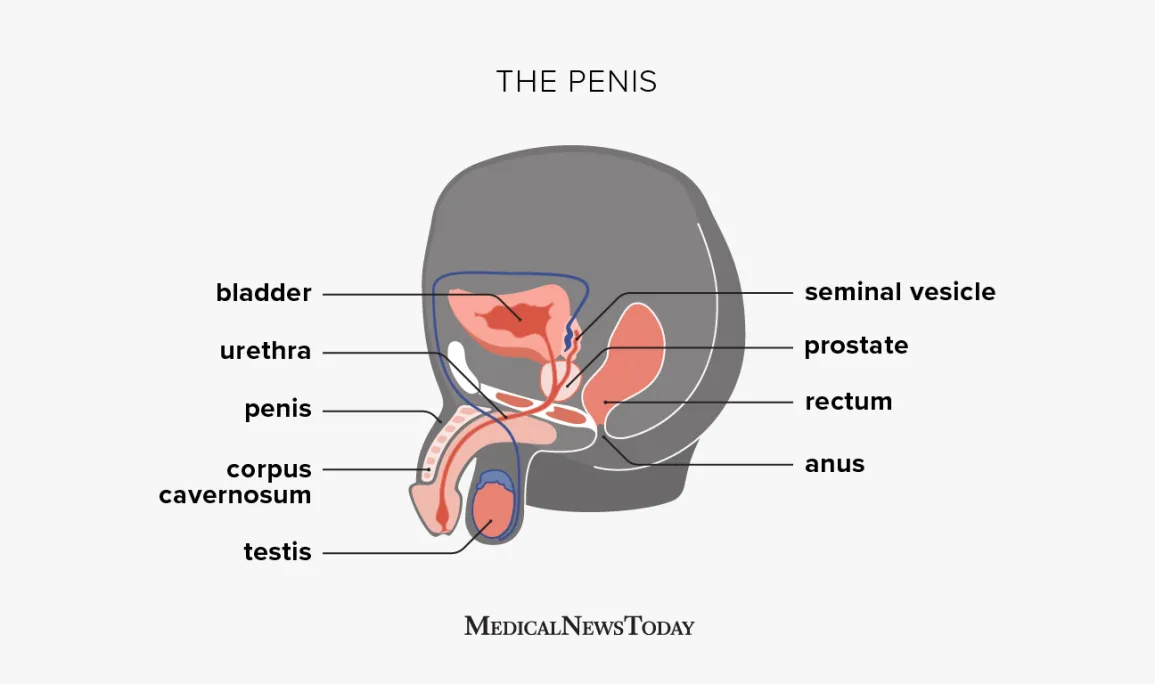
Most of the action happens out of sight. A quick tour of the internal hardware:
Bladder. Where the body holds urine until you’re ready to go.
Urethra. The single tube running from the bladder out through the penis. It carries both urine and semen – though never at the same time; the body has a valve for that.
Seminal vesicles. A pair of glands that make most of the fluid in semen – roughly 70 percent – and send it into the vas deferens to meet the sperm.
Prostate. The walnut-sized gland that adds the rest of the seminal fluid and sits at the crossroads of all of it. It’s also a source of real pleasure in its own right – more on that in our guide to prostate play.
Vas deferens. The tubes that carry sperm up from the testicles to meet the seminal fluid before ejaculation.
What You Can See
The shaft. The length of the penis, built around spongy tissue that fills with blood during an erection.
The head (glans). The sensitive tip, dense with nerve endings.
The scrotum. The sac that holds and protects the testicles and quietly manages their temperature – drawing them closer when it’s cold, letting them hang lower when it’s warm.
The testicles. Where sperm and most of the body’s testosterone are made.
And one thing worth saying plainly: they’re all different. Length, girth, curve, color – “normal” covers an enormous range, and nearly all of them work exactly the same.
How an Erection Actually Works
An erection isn’t a muscle flexing – there’s no muscle involved, and no bone. It’s blood flow. When you’re aroused, the spongy tissue in the shaft fills with blood, and the penis becomes firm and stands upright – which is what makes penetration possible in the first place. When the arousal passes, the blood drains and it softens again.
Erections aren’t always tied to arousal, either. They happen during sleep, from friction, or seemingly at random – especially during puberty. All normal.
Some men struggle to get or keep an erection. That’s erectile dysfunction, and while it’s more common with age, it can happen to anyone for plenty of ordinary reasons – stress, fatigue, medication, alcohol. If it’s persistent, it’s worth a conversation with a healthcare provider who can look at the actual cause. Be wary of internet “quick fixes” – the pumps and pills sold with big promises are, at best, a waste of money.
Ejaculation and Orgasm
Ejaculation is the release of semen from the penis, and it usually – but not always – arrives alongside orgasm. They’re two separate events that tend to happen together: orgasm is the wave of pleasure, ejaculation is the physical expulsion. Some men experience one without the other, and that falls within the range of normal too.
Five Things Worth Knowing
You can injure it.
There’s no bone to break, but the internal tissue can rupture during rough sex while erect – a painful injury called a penile fracture that needs prompt medical attention. Go easy when the angle gets awkward.
Morning and nighttime erections are normal.
They track with sleep cycles and have nothing to do with what you were dreaming about. If anything, they’re a sign the plumbing works.
Size doesn’t match foot or hand size.
A persistent myth with no basis – there’s no reliable correlation between penis size and any other body part.
Growers and showers are both normal.
Some penises look much larger erect than soft; others change far less. Flaccid size tells you very little about erect size.
It isn’t a muscle.
You can’t “work it out” to make it bigger or stronger – it’s blood flow and tissue, not muscle. (Which is exactly why those “quick fix” gadgets don’t deliver.)
Keep Reading
Curious about the prostate? Start with our road map to prostate stimulation and the beginner’s guide to anal plugs. Working on your technique together? Here’s how to blow like a pro.
Penis FAQ
Why do I get erections when I’m not aroused?
Erections aren’t always about arousal – they happen during sleep, from friction, or seemingly at random (especially during puberty). It’s completely normal.
What’s the difference between orgasm and ejaculation?
They usually happen together but are separate events: orgasm is the pleasurable release, ejaculation is the expulsion of semen. It’s possible to have one without the other.
Is erectile dysfunction only an older-guy thing?
No – ED can affect anyone at any age, for all sorts of reasons. If it’s persistent, see a healthcare provider, and be wary of internet “quick fix” pumps and pills.
Can the penis actually break?
Not like a bone – there isn’t one – but the internal tissue can rupture during rough sex while erect. It’s a real injury that needs prompt medical attention.
Does penis size relate to foot or hand size?
No – that’s a myth. There’s no reliable correlation between penis size and any other body part.